Java4Shell (CVE-2026-114938): The Bug That Leaked Before Its Patch
Java4Shell (CVE-2026-114938): The Bug That Leaked Before Its Patch On November 17, 2026, a...
Java4Shell (CVE-2026-114938): The Bug That Leaked Before Its Patch#
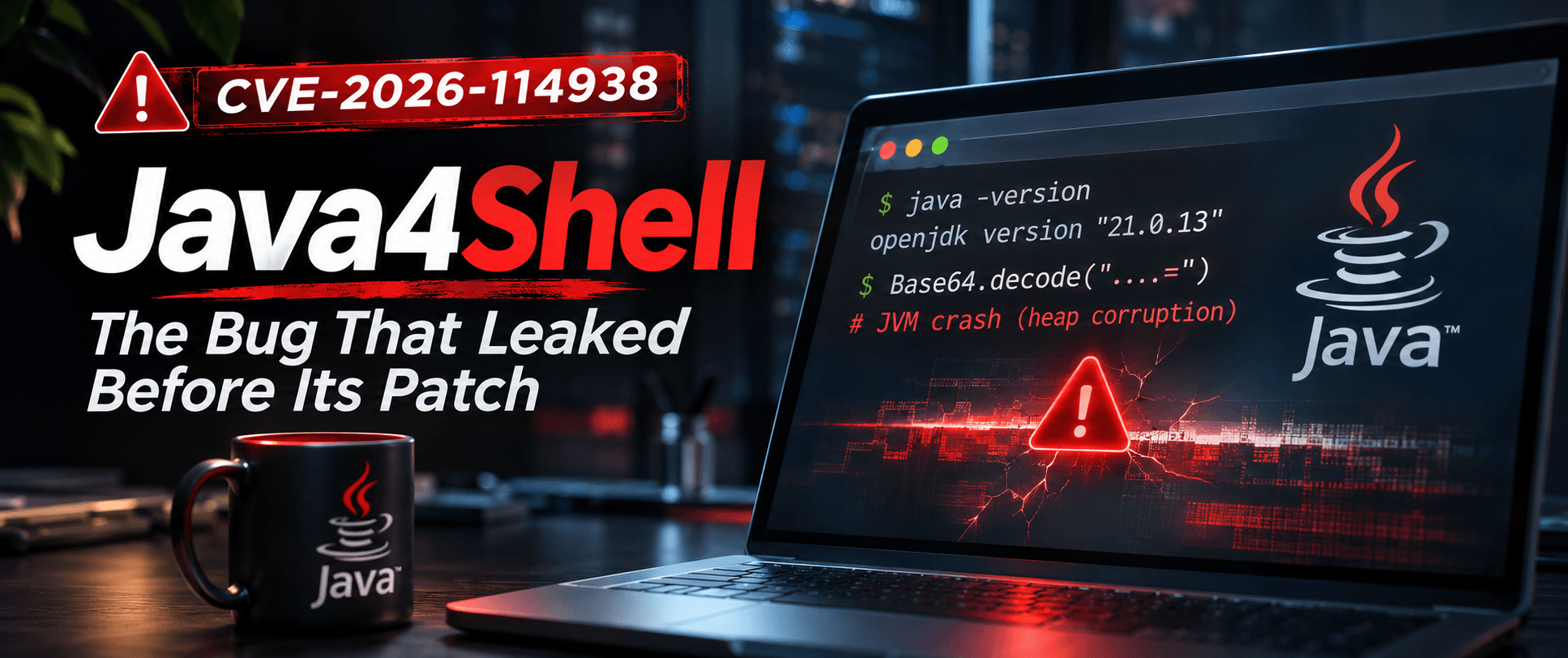
On November 17, 2026, a security firm called Calif published a write-up titled "Write once, RCE everywhere." The bug it describes, tracked as CVE-2026-114938 and nicknamed Java4Shell, lives in java.util.Base64, a class most of us have called without a second thought. Endor Labs calls the fix four lines. The names on the affected list are Keycloak, Jira, Confluence, Artifactory, Jenkins and PingFederate.
I spent the day reading the advisories and vendor write-ups so you don't have to. Some of what you will see on social media has a reproduction behind it. Some is Calif's claim with no public proof yet. I'll keep the two apart, because the difference decides how fast you need to move.
TL;DR#
| Question | Short answer |
|---|---|
| What is it | CVE-2026-114938, nicknamed Java4Shell, a heap out-of-bounds write in OpenJDK's hardware-accelerated Base64 decoder |
| How big is the write | 62 bytes past the end of the output array, per Upwind and Endor Labs |
| Who is at risk | HotSpot 17.0.6 and later, plus 21, 25 and 27, on x86-64 CPUs with AVX-512 VBMI |
| Who is not | ARM64, older Xeons, AMD before Zen 4, Java 8 and 11 (standard builds), and the MIME decoder |
| Exploitation | No exploitation in the wild reported, not in CISA KEV as of November 17 |
| Is there a fix | Oracle shipped fixed builds on November 17, other vendors on their own schedules |
How a Base64 string becomes a crash#
Base64 decoding is boring work, so HotSpot does not do it in plain Java. Once the JIT decides the decoder is hot, it swaps the Java loop for a hand-written assembly routine that uses AVX-512 to chew through the input in wide chunks. That gives the speedup, and it also hosts the bug.
The routine has a special path for the last characters of the string. Per Upwind, a malformed string that ends in a stray = makes that tail code calculate a negative output length. A small write turns into a full 64-byte write, 62 bytes past the end of the array. Java then notices the input is invalid and throws an exception. By that point the bytes are already in memory.
Those bytes are a constant. Endor Labs says the content of the overflow is the same whatever you send. The attacker does not choose what gets written. They choose where it lands by shaping the heap.
If the bytes land in free memory, nothing happens. If they land on a live object, they destroy its header. Endor Labs puts the usual result as a SIGSEGV inside garbage collection. That is the part everyone agrees on: a remotely triggerable JVM crash.
The part people argue about#
Calif says the overflow escalates much further. In their write-up, a chain of five stages corrupts an array length, uses a second array to leak heap contents, repairs object headers, grooms the heap remotely and finally writes into the JVM's code cache. Their claimed results are pre-auth RCE on default installs of Keycloak, Jira, Confluence, Artifactory, Jenkins and PingFederate, and post-auth RCE on Kafka, Solr, Elasticsearch, Gerrit and Spinnaker.
Here is what I could and could not confirm.
- Calif reports that they found the bug with AI help in about an hour and had a first working exploit about two hours later. That is their timeline, not an independently checked one.
- No public proof-of-concept shell exists. Calif is withholding the product-specific exploits and published a safe reproducer only.
- Calif itself says there is no universal exploit. Each target needs its own decoder route, writable buffer, feedback channel and heap layout.
- Equixly, writing the same day, calls RCE unproven and calls a JVM crash the realistic outcome.
Both readings can be true at once. A crash needs no skill. Code execution needs a skilled attacker per product, but the defenders' clock is Calif's own statement that product exploits will follow.
The numbers that matter#
| Number | What it is | Source |
|---|---|---|
| 62 | Bytes written past the array for a single = tail (63 for ==) |
Upwind, Endor Labs |
| 65 | Shortest trigger length on Java 21, 25 and 27 | Endor Labs, Equixly |
| 129 | Shortest trigger length on Java 17 | Endor Labs, Equixly |
| 9.2 | CVSS 4.0 score, attributed to the researchers | Qualys, Endor Labs |
| 8.1 | Oracle's CVSS 3.1 score for the November update | Qualys, Endor Labs |
| 11 | Java SE fixes in Oracle's November update, all remotely exploitable without auth | Endor Labs |
| Jan 2023 | Backport of the vulnerable decoder into 17.0.6 | Endor Labs |
| Oct 14, 2026 | Fix committed under embargo | Endor Labs |
The sources disagree on several details. Equixly attributes the 9.2 score to South Korea's NCSC while the others attribute it to Calif, and nobody has published a CVSS vector string. Treat the score as a signal, not a measurement.
Why this one has legs#
Three things make this more than a routine patch Tuesday item.
The first is the reach. This is not a library you can grep for in a lockfile. The flaw sits in the runtime itself, so dependency scanning of pom.xml or build.gradle will not surface it. Endor Labs says so directly, and that is the main reason I expect this to linger in fleets for months.
The second is that you can be vulnerable by accident of hardware. Qualys warns that a workload on an unaffected CPU can land on an affected one after a resize or an instance type change. The same container image, the same JVM flags, a different answer.
The third is the leak. Per Upwind and Endor Labs, the bug reportedly leaked before its patch was ready. The NCSC in South Korea told public institutions to inspect their Java runtimes on November 16, a day before the fix shipped.
What I would do before lunch#
Start by finding out which JVM each service really runs. The java on your shell path is often not the one your service uses, especially for Jenkins, Jira, Confluence, Keycloak and Elasticsearch, which bundle their own runtime.
# The real runtime behind a running service, not the first java on PATH
for pid in $(pgrep -f '[j]ava'); do
  echo "pid $pid  $(readlink -f /proc/$pid/exe)"
  jcmd "$pid" VM.version 2>/dev/null | sed -n '2,3p'
done

# Does this host have the CPU feature at all
grep -m1 '^flags' /proc/cpuinfo | tr ' ' '\n' | grep -E '^(avx512f|avx512bw|avx512vbmi|bmi2)$'
Qualys says a host meets the hardware condition only when all four flags appear. If the second command prints nothing, the host is not exposed to this particular code path, though I would still patch it.
Then patch. The Oracle fixed builds named by Qualys are 17.0.21.1, 21.0.13.1, 25.0.5.1 and 27.0.1.1, and Corretto 17.0.21.1.2. For Temurin, Zulu, Microsoft, Red Hat and your distro packages, check the vendor advisory, because I could not confirm their fixed builds today. Remember that a running JVM does not change when you replace files on disk. Rebuild images and restart processes.
If you cannot patch today, the workaround both Qualys and Upwind recommend is a JVM flag.
java -XX:-UseBASE64Intrinsics -jar app.jarIt switches off the fast decoder, so heavy Base64 workloads may slow down. Test before rolling it out. One warning from Upwind that I want to repeat: a variant circulating online, -XX:DisableIntrinsic=_base64_decodeBlock, stops the JVM from starting on its own and becomes a fleet-wide outage when pushed through JAVA_TOOL_OPTIONS. Endor Labs lists it only together with -XX:+UnlockDiagnosticVMOptions. Skip it and use the flag above.
The bottom line#
I have not reproduced this myself, and I would not trust any article that claims to have run Calif's chains without Calif's code. What the public record supports today is a real, remotely triggerable memory-safety bug in the runtime that carries a vendor fix and a one-line mitigation. Whether it becomes the next Log4Shell depends on whether Calif's promised product exploits arrive before your restart window closes.
Here is the question I would put to your team today: if someone asked you to list every JVM your company runs, including the ones inside vendor appliances, how long would that take?
GDS K S · thegdsks.com · building Glincker · follow on X @thegdsks
The scariest runtime bugs are the ones your dependency scanner cannot see.
Sources: Upwind, Endor Labs, Qualys, Equixly, Calif.